Day: October 25, 2026

on

Best OnlyFans Creators – How to Choose the Right Ones for You

Understanding the OnlyFans Platform

What is OnlyFans?

OnlyFans is a subscription‑based platform that lets creators share exclusive photos, videos, and written content directly with fans. Unlike many social networks, it offers a built‑in payment system, allowing creators to monetize their work through monthly fees, pay‑per‑view messages, and tips.

The platform is open to a wide range of creators—from fitness coaches and chefs to artists and adult entertainers. This diversity means the best onlyfans creators can be found in many niches, each catering to specific audience interests.

How Creators Monetize Their Content

Creators set a monthly subscription price that fans must pay to access their private feed. In addition to the recurring fee, many creators offer premium content for a one‑time charge or accept tips for personalized requests. This layered pricing gives fans flexibility while helping creators maximize revenue.

Understanding these monetization options is essential when evaluating a creator’s value proposition. Look for clear pricing tiers, regular updates, and transparent communication about extra charges.

Criteria for Identifying the Best OnlyFans Creators

Not every creator will meet your expectations. Use the following criteria as a checklist when you browse potential subscriptions.

  • Consistency: Regular posting schedule (weekly or more) keeps the experience fresh.
  • Engagement: Creators who reply to messages and run polls show a commitment to fan interaction.
  • Production Quality: Clear visuals, good audio, and thoughtful editing indicate professionalism.
  • Transparency: Clear explanations of pricing, content boundaries, and refund policies.
  • Community Feedback: Positive reviews from existing subscribers provide social proof.

When a creator checks most of these boxes, they are likely among the best onlyfans creators for your interests.

Top Categories of Creators and What to Expect

OnlyFans hosts a variety of niches. Knowing which category aligns with your preferences helps narrow the search.

  • Fitness & Wellness: Work‑out routines, meal plans, and live coaching sessions.
  • Creative Arts: Exclusive sketches, behind‑the‑scenes video, and tutorials.
  • Lifestyle & Travel: Personal vlogs, travel diaries, and curated photo journals.
  • Adult Entertainment: Personalized adult content with customizable requests.
  • Education & Skill‑Sharing: Language lessons, coding tutorials, and professional advice.

Each category has its own set of features and pricing models. Identifying the right category ensures you invest in creators who match your specific business needs or personal interests.

The table below summarizes a few well‑known creators across different niches, focusing on the features that matter most when judging the best onlyfans creators.

Creator Category Subscription Price (USD) Notable Feature
Note: Prices and features are illustrative and may change over time.
FitLifeGuru Fitness & Wellness $15 / month Live workout streams with real‑time feedback
ArtisanSketch Creative Arts $8 / month Weekly behind‑the‑scenes process videos
TravelNomad Lifestyle & Travel $12 / month Monthly travel diary PDFs and Q&A sessions
IntimateMoments Adult Entertainment $20 / month Custom content requests with fast turnaround
CodeMentorPro Education & Skill‑Sharing $10 / month Live coding workshops and project reviews

Use this overview as a starting point, then dive deeper into each creator’s dashboard to assess reliability, support, and scalability of their content delivery.

Pricing Models and What You Pay For

Most creators adopt a tiered pricing structure. The base subscription unlocks the primary feed, while additional charges cover premium content, private messages, and custom requests.

  • Standard Subscription: Grants access to daily posts and standard media.
  • Pay‑Per‑View (PPV): One‑time fees for exclusive videos or photos not included in the subscription.
  • Tips & Custom Requests: Direct financial support for personalized content, often negotiated through the messaging system.

When evaluating the best onlyfans creators, compare the total cost of ownership across these models. Some creators bundle PPV content into higher‑tier plans, which can be more cost‑effective for frequent consumers.

For a quick reference on the most popular options, check out the most viewed onlyfans page, which aggregates trending creators and pricing trends.

How to Set Up and Manage Your Subscriptions Safely

Security and privacy are paramount on a paid platform. Begin by creating a strong, unique password and enabling two‑factor authentication (2FA) if available.

Once logged in, the dashboard provides tools to track billing cycles, cancel subscriptions, and manage payment methods. Use the built‑in automation settings to receive notifications before a renewal, helping you avoid unwanted charges.

Regularly review your payment history and ensure that your credit card information is stored on a secure, encrypted server. If a creator requests direct payments outside the platform, consider it a red flag and report the activity to OnlyFans support.

Support and Community Resources

OnlyFans offers a help center that covers account issues, payment disputes, and content guidelines. Look for FAQs that address common concerns such as subscription refunds, content removal, and privacy settings.

Many creators also maintain auxiliary community channels—Discord servers, Telegram groups, or private forums—where fans can exchange tips and ask questions. These secondary resources can be valuable for troubleshooting technical problems or learning how to get the most out of a creator’s workflow.

Common Mistakes to Avoid When Following OnlyFans Creators

Even seasoned users can fall into pitfalls that diminish the value of their subscriptions. Below are frequent errors and how to prevent them.

  • Signing up for multiple creators without reviewing their posting frequency—focus on those who deliver consistent content.
  • Ignoring the creator’s content policy—respect boundaries to maintain a positive relationship.
  • Overlooking renewal dates—set calendar reminders to avoid surprise charges.
  • Sharing login credentials—this compromises security and can lead to account suspension.

By staying aware of these issues, you can maintain a smooth and rewarding experience with the best onlyfans creators.

Final Checklist Before You Subscribe

Use this quick checklist to ensure you’re making an informed decision.

  1. Verify the creator’s posting schedule and engagement level.
  2. Review pricing tiers and any additional PPV costs.
  3. Confirm the platform’s security settings (2FA, encrypted payment).
  4. Read recent subscriber reviews for reliability and support quality.
  5. Determine if the creator’s niche aligns with your personal or business interests.

Completing this checklist will help you select creators who truly fit your needs and get the most out of your investment.

on

Free OnlyFans International – How to Access Content Legally and Safely

Understanding “Free OnlyFans International”

OnlyFans is a subscription‑based platform that hosts a wide range of creators, from fitness coaches to artists. The phrase “free onlyfans international” is often searched by users looking for ways to view this content without paying, especially when they are located outside the creator’s primary market. While the platform itself does not officially provide free worldwide access, several legitimate pathways exist for new users to explore content at no cost. Recognizing the difference between official promotions and dubious shortcuts is the first step toward a safe experience.

International users face additional hurdles such as currency conversion, regional payment restrictions, and varying age‑verification rules. Understanding how these factors interact with OnlyFans’ policies helps you set realistic expectations and avoid common pitfalls that lead to blocked accounts or compromised personal data.

Who Actually Benefits from Free Access?

The primary audience for free onlyfans international searches includes curious newcomers, occasional viewers, and creators who want to test the platform before committing financially. For newcomers, a trial period can provide a taste of the community without the pressure of an immediate subscription. Occasional viewers might only be interested in specific content types, such as cooking tutorials or fitness classes, and prefer to access them selectively.

Creators also benefit indirectly when platforms offer limited‑time free passes; it can increase exposure, attract a broader audience, and potentially convert free viewers into paying subscribers later. However, the benefit is only real when the free access is sanctioned by the creator or OnlyFans itself.

Common Methods – What Works and What Doesn’t

Official promotions and trial periods

OnlyFans periodically runs promotional campaigns that grant new accounts a limited number of free views or a 7‑day trial. These offers are typically advertised on the official blog, through the creator’s social channels, or via email newsletters. Signing up for these promotions requires a valid email address, age verification, and often a payment method to be added for seamless transition after the trial ends.

The advantage of official methods is that they keep your data within OnlyFans’ secure environment, preserving privacy and ensuring compliance with local regulations. They also provide a clear path to upgrade if you decide the content is worth the subscription.

Third‑party aggregators (risks)

Numerous websites claim to host “free onlyfans international” streams without any subscription. While some may appear functional, most operate in a legal gray area, redistributing copyrighted material without permission. Using these services can expose you to malware, phishing, and potential legal consequences.

Beyond security risks, such sites often require you to provide personal details or install browser extensions that harvest data. In many jurisdictions, accessing pirated content can lead to civil penalties, making it a poor choice for any serious user.

Step‑by‑Step Setup for a Safe Experience

Below is a practical checklist to get started with a legitimate free trial while protecting your personal information:

  1. Visit the official OnlyFans website and click “Sign Up”.
  2. Enter a reliable email address and create a strong password.
  3. Complete age verification using a government‑issued ID (OnlyFans stores this securely).
  4. Link a payment method—most users use a prepaid or virtual card to avoid exposing primary banking details.
  5. Look for any active promotion banners or check the creator’s social media for free‑access codes.
  6. Activate the trial, explore the content, and set a reminder to cancel before the trial ends if you decide not to

Start your legitimate free OnlyFans trial now by visiting best free only fans sites.

on

We Are Righteous: The Origin Story Behind the Brand

A backstory that nearly every clothing brand puts forth, yet hardly any can trace it back to the specific tension that made the brand necessary at the outset. We Are Righteous grew out of a plain source of dissatisfaction: too many apparel companies were selling swagger without substance, stamping taglines on flimsy cotton and calling it culture. The people behind We Are Righteous sought something more solid — in both a physical and symbolic sense. Their goal was garments that were built to survive daily wear while carrying a name that held significance to whoever wore it. The pairing of resilience and purpose is even now the common strand running through the brand today.

The name itself — and the thinking behind it — is what distinguishes this origin story from the usual “we started in a garage” narrative. Righteous isn’t a casual word chosen because it sounded cool on a label tag. It was picked because it signals holding steady in what you believe, regardless of trend cycles or external pressure. This mindset influenced everything from the first sketches to the material-sourcing choices that came later. Understanding this backstory helps explain why the brand’s wearers talk about it differently than they describe rival labels in the space.

Where the Righteous Clothing Brand Started

The earliest version of the righteous clothing brand wasn’t a complete lineup — it was a small set of pieces designed to test whether the concept would hold up. The team mapped out ideas around a guiding principle: clothing should function as a understated declaration of identity, not a attention-grabbing stunt. Their aim was to create pieces that held their appearance in year three as they did on day one, which entailed steering away from less expensive construction methods in favor of stronger stitching and denser materials right from launch.

More than most founders acknowledge, this early rigor counted. A lot of apparel ventures kick off with a logo and a aspiration, then rush to fix quality issues after the first wave of shopper grievances. We Are Righteous took the contrary route, devoting extra time on fit testing and fabric trials before releasing anything publicly. The first drop was intentionally small, limited to a few foundational styles, yourighteous.com/t-shirts so the team could gather genuine input instead of guessing at scale. Such a feedback process became a enduring element of how the brand runs, continuing to guide choices in 2026 the same way it did at launch.

On top of that, there’s a communal thread to the backstory that’s often overlooked. The founders weren’t trying to build a brand in isolation — they wanted people who related to the “righteous” mindset to feel like they had found something built for them specifically. Those early supporters went beyond simply buying; they were regarded as partners, with their views on fit, color, and fabric weight shaping the following production run. So many long-term fans describe the brand as feeling personal rather than corporate, which stems largely from that dynamic.

The Guiding Principle Behind Righteous Apparel

At the center of every righteous apparel release is a simple test: does this piece hold up to both physical wear and the values the brand claims to represent? That two-part filter shows up in decisions about stitching density, fabric weight, and even which prints make it to production. The team has said no to plenty of designs that looked fine on paper but didn’t match the brand’s standard for longevity or message.

Here, it’s not about a brand racing after each passing trend flashing across social media. Instead, the design process leans toward pieces with staying power — shapes and palettes that won’t feel outdated within eighteen months. This stands in intentional opposition to fast fashion’s pattern of overproduction and rapid obsolescence, which regularly rolls out new “must-have” items every couple of weeks while tossing aside last month’s version almost immediately. Because the team is optimizing for a five-year wear life, not a five-week trend window, Righteous apparel takes longer to develop.

There’s also a strong commitment to transparency that is reflected in customer communication. Size guides, material makeup, and care details are laid out plainly rather than tucked away in dense legal text, because those behind the brand are convinced being upfront, not sales-driven wording, is what creates trust. The payoff has shown up in how often customers return — the brand’s core hoodie line sees repeat buyers outpacing one-time shoppers by a consistent margin, according to figures from the brand’s internal tracking, as mentioned in previous updates.

The Righteous Hoodie as a Flagship Piece

If there’s one product that defines the brand’s identity, it’s the righteous hoodie. Its ascent to flagship status happened almost unplanned — early customers kept reordering it in different colorways faster than any other product in the catalog, and the team took notice. What drives the garment’s appeal goes beyond the name emblazoned across the chest; it comes down to a fit that suits varied body types and a thickness that performs well in chillier months without turning bulky.

Manufacturing choices for the hoodie embody the label’s wider ethos. Strengthened cuffs, seams stitched twice over at high-wear points, and a textile mix chosen for being soft yet hard-wearing all trace back to that original principle: clothing should last, not just look good in a product photo. Multi-season owners often mention in their reviews that the hoodie keeps its shape and color better than comparable pieces from larger competitors, and for loyal wearers, that outweighs any amount of flashy marketing.

Among the brand’s following, the hoodie has evolved into something like a cultural signal. To wear it is to show you understand the brand’s origin story and values, beyond just admiring the design. That kind of thing is far harder to fabricate than a solid logo — it demands steady product quality across multiple release cycles, and that’s precisely what the flagship hoodie has delivered since it debuted in the catalog.

The Real Story Behind a Righteous Review

Search for a righteous review online in 2026 and a pattern emerges quickly: shoppers pay less attention to hype and more to fit, how the fabric feels, and whether the piece matches what’s described. That’s a meaningful shift from the exaggerated unboxing culture that dominates a lot of streetwear marketing. Reviewers covering We Are Righteous tend to zero in on particular details — the fit of the hoodie after several washes, the durability of the stitching, and whether sizes run true.

That level of detail in a we are righteous review reflects the brand’s genuine performance rather than just its promotional messaging. Reviews that focus on durability after repeated wear, rather than just first impressions, tend to carry more weight with prospective buyers, and that’s exactly the type of feedback this brand has built its reputation on.

Common themes across a we are righteous review also touch on customer service responsiveness and how closely the finished product matches what’s shown online. Consistency between marketing images and the delivered item is one of the most frequently praised aspects, since so many online apparel brands struggle with that exact gap. When customers say the product “looks like the photos,” that’s a meaningful signal in an industry where mismatched expectations are common.

Comparing the We Are Righteous Brand

To frame the brand’s approach, here’s a look at how its key attributes measure up against typical fast-fashion competitors within the same price tier.

Feature We Are Righteous Typical Fast-Fashion Competitor
Release cadence Seasonal drops geared toward long-term wear Weekly releases chasing trends
Material philosophy Sturdier weight with reinforced seams Lightweight, cost-minimized
Feedback process Direct customer input informs future batches Minimal, data-driven only
Flagship product Righteous hoodie, repeat-purchase favorite Ever-changing “hero” items and poor customer retention
Messaging strategy Values-driven, consistent Inconsistent messaging chasing trends

This comparison isn’t meant to dismiss competitors outright — quick-turnaround clothing systems have a purpose for shoppers prioritizing low prices over longevity. What becomes obvious, though, is why countless shoppers seeking out a righteous clothing brand stick around after trying a piece themselves. The brand’s value proposition is distinct intentionally, not coincidentally.

The Brand’s Position as of 2026

Looking ahead to 2026, We Are Righteous keeps growing its product lineup while holding onto the same founding principles that defined its earliest release. Additional color options and silhouettes have been added, but the emphasis on durable fabric and honest marketing has remained steady. Its expansion has been measured rather than rapid, which fits its philosophy of building slowly and steering clear of the overreach that topples so many clothing startups.

As a measure of how the brand is doing, customer loyalty remains the clearest signal. Season after season, the flagship hoodie holds its place as a leading seller, while repeat buyers keep anchoring sales. For anyone on the fence about trying it out, the founding story offers a useful lens: this isn’t a label chasing quick virality, but one built around a specific belief that clothing should reflect values as much as style. That distinction is exactly what continues to set righteous clothing apart in a crowded market.

on

Valentino Bag Materials: Exactly Where the Premium Actually Goes

Two Valentino bags with the same name, the same silhouette and the same stud count can still be four thousand dollars apart. The variable is very nearly always material. Within a single line the house prices hide, finish and surface in clear, legible steps, and the range stops looking arbitrary as soon as those steps are legible. $1,390 in grainy calfskin or suede, $1,850 in pony-effect calfskin: the same Rockstud mini shopping bag at a 33 percent premium attributable entirely to the hide. Panthea goes further again, climbing from $3,800 in nappa and suede to $5,650 in python and $7,600 in ostrich, exactly double the base. Treat each number below as an observed 2026 market price on the brand’s own US site, not an official price list.

Grainy Calfskin: The Benchmark Everything Else Is Measured From

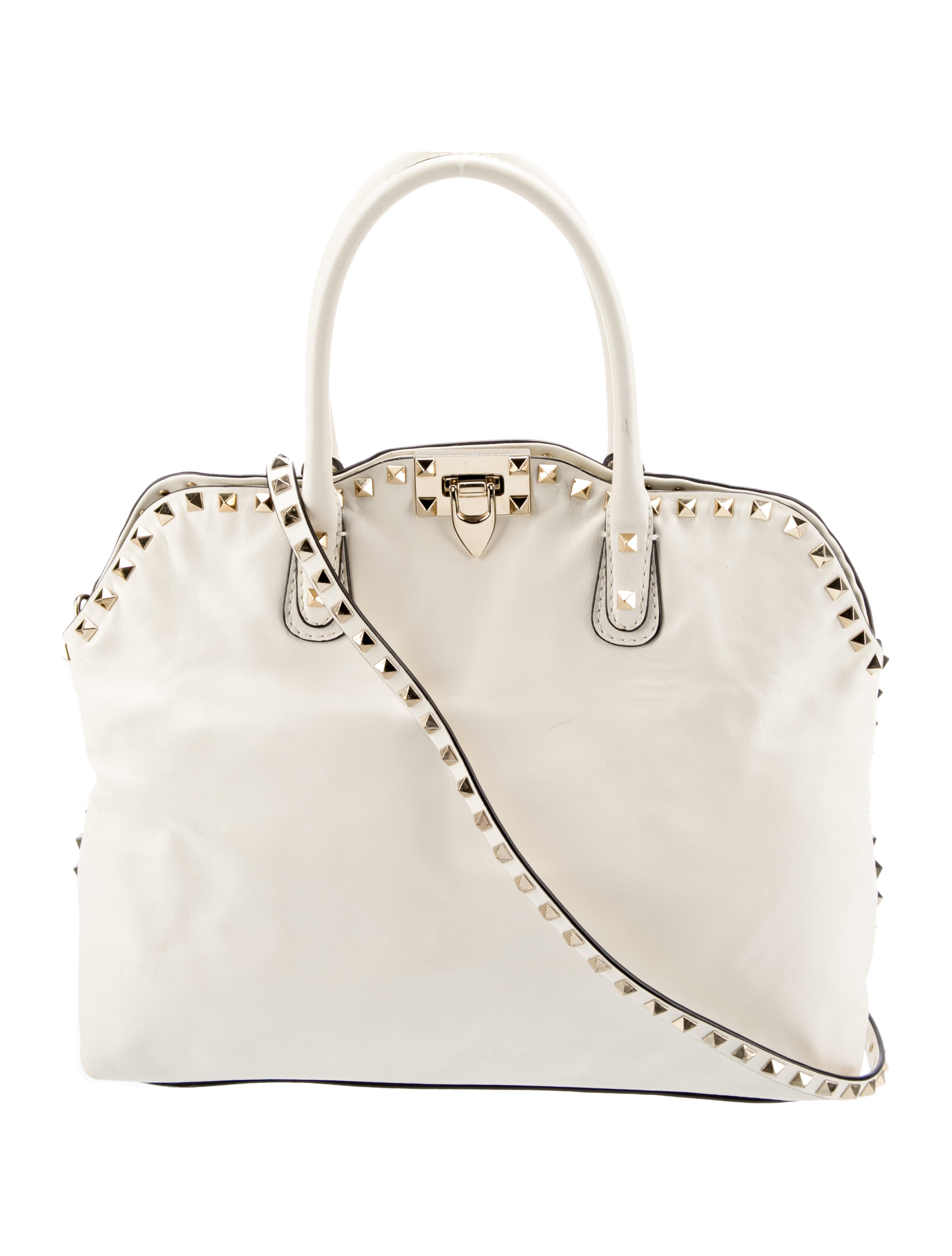
As reference material and sensible default alike, grainy calfskin sets the standard. No other hide in the range keeps its shape and resists scuffing as well, and it demands no routine. It sits at the foot of most ladders too: the Rockstud mini shopping bag, the accessible Valentino tote bag, starts at $1,390 in grainy calfskin, the small Valentino crossbody bag runs $1,650 to valintinobags.com/mini-bags $1,950, and the small shoulder version reaches $2,100. Grainy calfskin is the VSling entry at $3,350, and the VLogo Signature clutches at $650 to $790 use it too. Because grain conceals fingerprints, disguises minor abrasion and still photographs well after several years of use, it dominates the resale listings that look presentable. This is the material every other rung is measured against on a Valentino bag that will be carried rather than stored.

Suede and Kidskin: Texture Without the Premium

Suede matches grainy calfskin at the accessible end and sits only a little above it higher up. $1,390 buys the Rockstud mini shopping bag in suede exactly as it does in grainy calfskin, and the small Valentino shoulder bag drops in suede at $1,950 against $2,100 in grain. Small suede is $2,550 in Rockstud Spike, medium suede $2,750 to $3,200, and medium kidskin at $2,950 falls between suede and nappa. In other words, texture adds almost nothing. The bill arrives as maintenance instead: suede wants a dry brush, a protector spray and firm avoidance of rain and oils, and it will not forgive a spilled drink the way grain will. Pick either for the matte, light-absorbing look, but as a second bag rather than the one that lives in a car footwell.

Nappa: The First Step Up the Ladder

Nappa marks the first premium that the figures make plain. Small nappa is $2,800 in Rockstud Spike where small suede is $2,550, and medium nappa is $3,500 where medium suede is $2,750 to $3,200. The step is roughly ten percent at the small size, and as much as a quarter more against the cheapest medium suede. Nappa is a soft, smooth lambskin, and it is what the house reaches for when a design depends on quilting holding its geometry. Nappa underpins the Roman Stud chevron and rhombus quilting with tone-on-tone stitching, the Panthea chevron at $3,800 and the Jean medium shopping bag at $3,650. Nappa takes a mark more readily than grain and burnishes at the corners, a trait some owners like and others do not.

Laminated, Metallic and Pony-Effect: What the Surface Costs

Above plain hides and below decoration sit the surface treatments, and the Rockstud mini shopping ladder makes the arithmetic plain. The steps are $1,390 in grainy calfskin or suede, $1,490 in raffia, $1,750 in laminated calfskin and $1,850 in pony-effect calfskin, which puts lamination at a 26 percent premium and pony-effect at 33 percent. The same laminated calfskin appears on the small Rockstud crossbody at $1,790, on a Rockstud wallet at $1,250 and behind the laminated Locò with jewel logo at $3,200. DeVain opens the widest single-line spread of any surface pair, from $2,100 for a jacquard lurex small shoulder bag to $3,900 for the same silhouette in metallic mesh, an 86 percent difference. With all of these the failure point is the finish, not the leather, and that is the caution to remember. Where a plain hide merely scuffs, a laminated or metallic surface abrades, which makes these the bags that reward a dust bag and punish a crowded wardrobe rail.

Raffia, Linen, Denim and Jacquard: The Rungs That Come and Go

There are also materials here that are neither cheap nor especially durable in the conventional sense. At $1,490 in the Rockstud mini shopping bag, only $100 above grainy calfskin, raffia is unmistakably a summer object, with a short annual window. Locò offers embroidered linen at $3,100, above plain calfskin in the same line. Denim appeared on the small Roman Stud The Handle Bag at $3,550, measuring 21 by 17 by 14 centimetres with quilted argyle, antique-brass studs, a front twist-lock and a rear magnetic closure, made in Italy, though that piece was marked as a reserved product rather than orderable and Roman Stud now reads as a line drifting toward resale. Jacquard lurex sets the entry to DeVain at $2,100. What sets these prices is construction complexity and short production runs rather than the cost of the material itself.

Embroidery, Crystals and Pearls: Where the Step Is Steepest

Nothing attracts a larger premium than decoration, and nothing is less connected to function. Rockstud Spike shows medium embroidered nappa at $3,700 against $3,500 for plain medium nappa, a modest step. The full arc is clearest in Locò: calfskin small at $2,700 to $2,950, jewel logo at $3,350, embroidered at $4,700 to $5,100 and pearls with rhinestones at $5,900, more than double the base. The same curve reappears in VSling: $3,350 in grainy calfskin, $5,600 to $6,000 for a mini embroidered version and $6,550 for the mini with pearls and rhinestones. Hand-applied work measured in hours is what you are paying for, and the price follows the density of that work rather than the bag’s size — which is why the most expensive VSlings are the smallest. For practical purposes these are event pieces, since a crystal setting is a mechanical part that can loosen and a bead field cannot be spot-cleaned.

Python and Ostrich: The Top Rung

The clearest exotic ladder in the range at present is Panthea. The nappa and suede chevron version is $3,800, python is $5,650 for a 49 percent premium, ostrich is $7,600 at exactly double the base, and an embroidered version tops the line at $7,900. Scarcity and yield price exotic skins, since a single hide produces far fewer usable panels than a calf, along with the matching required to make a pattern read cleanly across a finished bag. Python has a scale pattern that must be aligned; ostrich has quill follicles whose spacing and prominence vary across the hide and are graded accordingly. Professional care is essential for both, and neither tolerates direct sun — a real limitation, not a formality. These draw a much smaller resale buyer pool than an instantly recognisable studded bag, so the motif matters more than the skin if the goal is a bag still desirable in ten years.

The Premium, in Numbers, and What to Do With It

The table puts each current line’s cheapest material against its most expensive, so the premium is visible as a percentage rather than a feeling. To make a decision, read it backwards: settle how the bag will live, then pick the rung that survives it. Grainy calfskin is the correct answer for a Valentino Garavani bag in daily carry, travel and commuting, and it happens to be the cheapest rung — a rare alignment. Nappa and suede repay their ten to twenty-five percent step in how they feel in the hand, for a bag worn a few times a month with intent. Where surfaces and decoration are involved, budget for careful storage, because abrasion and loosened settings, not structural failure, are what end those bags. A seasonal Valentino bag sale moves the sticker and never the ladder, and one storage rule covers all of it: dust bag, the supplied insert or acid-free tissue, cool, dry and never compressed.

Line Entry observed material Highest observed material Step
Rockstud mini shopping Grainy calfskin or suede at $1,390 Pony-effect calfskin at $1,850 +33%
Rockstud Spike Small suede at $2,550 Medium embroidered nappa, $3,700 +45%
DeVain Jacquard lurex shoulder at $2,100 $3,900 for the metallic mesh shoulder +86%
Locò Calfskin small at $2,700 Pearls and rhinestones, $5,900 +119%
VSling Grainy calfskin small, $3,350 Mini with pearls and rhinestones, $6,550 +96%
Panthea Nappa and suede chevron at $3,800 Ostrich $7,600; embroidered $7,900 +100% to +108%
VLogo Signature Grainy calfskin clutch at $650 $3,750 for suede or soft leather shopping +477%